Norfolk trip
Never Let Me GoThe Norfolk trip is an outing to find Ruth’s possible, but its decisive turn is the collapse of that hope. Kathy H., Ruth, Tommy, Chrissie, and Rodney set out from the Cottages expecting to test whether a woman Rodney has seen at work might be the person from whom Ruth was modeled. The search first invites them to imagine a life beyond their own; when that imagined resemblance fails, Ruth gives blunt expression to what the group has been reluctant to say about their origins and social place.
Background and departure
Chrissie and Rodney’s confidence in the search grew from their awe of Hailsham. Though Chrissie had initially treated the younger students with a slightly patronizing manner, Kathy later recognizes that she regarded being from Hailsham as a special distinction. Ruth’s occasional stories about an office job had encouraged Chrissie to imagine that Hailsham students might be subject to a separate set of rules. Ruth did not, as Kathy recalls it, directly lie; she allowed some assumptions to stand and suggested others without correcting them. Kathy sometimes could have exposed the gap between Ruth’s stories and reality, but chose not to.
That background makes Kathy wary when Chrissie and Rodney claim to have seen Ruth’s possible. She does not want Ruth to go to Norfolk, though she cannot explain her reluctance at first. Ruth is determined to go, and Kathy decides to accompany her. Ruth initially seems less than pleased, and appears for a time unwilling to include Tommy either. In the end all five go together. The journey thus begins with a fragile social arrangement: Ruth wants to make an impression on the veterans, while Kathy and Tommy are also part of the group whose Hailsham identity has helped make the search seem plausible.
The trip itself nearly falls through before it begins. Rodney, who has a driving licence, had arranged to borrow a car from farm-workers at Metchley, a couple of miles away, but that arrangement broke down the day before departure. He walked to the farm and secured the promise of another car, so the outing went ahead. Kathy singles out Ruth’s response during the hours when cancellation seemed possible, although the account here does not specify what Ruth did. The threatened interruption nonetheless makes clear how firmly she is set on going.
The journey and the seaside town
The group travels through the night and, after about an hour on the road, stops as day is breaking. Beside a large empty field, they jump over a ditch to stretch and warm their hands. Kathy notices Ruth standing apart, looking across the field toward the sunrise. She suggests that Ruth exchange seats with her: Ruth could continue talking with Chrissie, while Kathy and Tommy could talk together. Ruth reacts sharply, pulling Kathy around so their backs face the others and they can argue without being seen. Her concern, Kathy realizes, is not simply the seating arrangement. Ruth is trying to present herself—and, by extension, all of them—to Chrissie and Rodney in the right way, and fears that Kathy will cause an embarrassing scene. Kathy touches Ruth’s shoulder and returns to the group; the seating stays as it was. Ruth then sits back and answers Chrissie and Rodney’s attempts to speak with her in sulky monosyllables.
The mood lifts when they reach a seaside town around lunchtime. They leave the Rover beside a mini-golf course marked by fluttering flags. The day is crisp and sunny, and the five feel exhilarated simply to be out together. Rodney whoops and waves his arms as he leads them up a road past houses and shops, toward the sea. From the cliff-edge road, they first see what looks like a sheer drop to the sand; leaning over the rail reveals footpaths zigzagging down the cliff face. Hungry, they stop at a small café perched near one of the paths. Its two workers, smoking at a table, retreat to the kitchen, leaving the visitors alone in the room. For a while, the outing’s immediate pleasures overshadow the purpose that brought them there.
The office behind the glass
After the seaside interlude, the group follows Rodney in search of the office where he says he saw Ruth’s possible the previous month. Their mood is already strained, and Rodney repeatedly chooses wrong turns from the High Street. At least four times he leads them toward a stretch where the shops and offices run out, forcing them to turn back. He becomes defensive and nearly gives up, but then stops and silently points across the street.
The office is not identical to the advertisement they once found on the ground, though it resembles it. Its large glass frontage makes the workroom visible from the street: about a dozen desks arranged in irregular L-shapes, potted palms, shiny machines, and curved desk lamps. Employees move between desks, lean on partitions to chat, or pull swivel chairs together to share coffee and sandwiches. The room looks comfortable and self-contained, a complete everyday world exposed to view. Tommy observes that the employees are eating lunch at their desks rather than going out, and says he cannot blame them. Ruth, however, looks anxiously from face to face behind the glass. The more closely the group inspects the scene, the more the possibility becomes a test of likeness rather than a passing resemblance in an advertisement.
The gallery and the failed identification
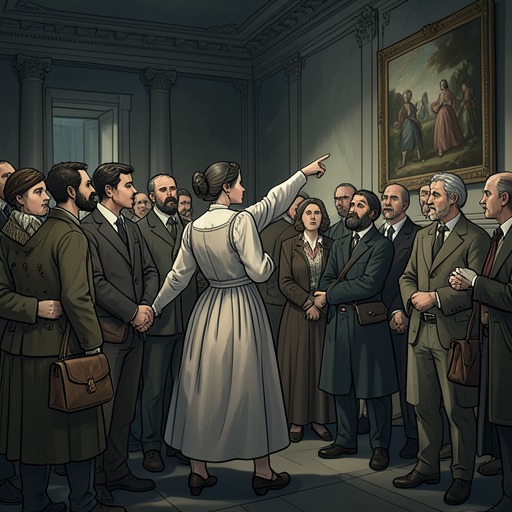
The group follows the woman they have taken to be Ruth’s possible into a gallery. Inside, she is speaking with a much older, silver-haired woman who seems to be in charge. The visitors spread out and pretend to study the paintings. Kathy, preoccupied with the search, nevertheless finds herself drawn into the quiet of the room: peppermint-colored walls and ceilings, fragments of fishing net and rotted boat wood near the cornicing, and mostly oil paintings in deep blues and greens with sea subjects. Tired after travelling since before dawn, the five drift into separate corners and make occasional hushed comments about the pictures.
The women’s conversation carries across the gallery. They are discussing a man they both know and his lack of understanding of his children. That ordinary conversation changes the group’s perception. Seen through the office window, the woman could still sustain the hopeful resemblance; heard at close range and watched in the gallery, she becomes increasingly unlike Ruth. Kathy senses the change spreading among them and sees that Ruth, absorbed in a picture on the other side of the room, feels it too. They linger rather than confer, as if delaying the moment when they must acknowledge what they have seen. When the woman leaves, none of them follows her. Their silence and avoidance of one another’s eyes register a shared conclusion before anyone states it.
Back near the cliff edge, where boarded-up stalls line the promenade below, Chrissie says that they agree the woman is not Ruth. She apologizes and touches Ruth’s shoulder, conceding that the resemblance through the office windows had made the attempt understandable. Rodney also apologizes, but does so with a smile that suggests he does not expect to be blamed for having tried to help. Ruth gives little away: she says nothing, shrugs off the touch, and looks toward the sky rather than the water. Kathy can tell she is upset, though a stranger might mistake her expression for thoughtfulness. The failed identification is therefore not only a disappointment about one woman. It exposes how much hope the group had invested in an image glimpsed through glass.
Ruth’s account of their origins
Ruth eventually says she knew all along that the idea was stupid. Tommy tries to soften the admission by calling the search a bit of fun, but Ruth rebukes him and insists that no one is listening. She then tells Chrissie and Rodney that people do not use someone like the woman as a model for them. Kathy attempts to stop her, but Ruth continues, listing the kinds of people she believes they come from: addicts, prostitutes, alcoholics, tramps, and possibly convicts, provided they are not psychopaths. She argues that the older woman in the gallery had taken them for art students and would have thrown them out if she had understood who they really were. In Ruth’s account, a serious search for possibles would mean looking in the gutter or rubbish, not in a polished office or among people living respectable lives.
Rodney responds steadily, warning Ruth to drop the subject and suggesting that they go to see Martin, who is free that afternoon. Chrissie puts an arm around Ruth and encourages her to go along. Their gestures return the scene to the group’s practical effort to comfort her, but they cannot undo what the search has brought into the open. The trip begins with a possibility sustained by Hailsham’s special standing and Ruth’s suggestive stories; it ends with the distinction Ruth draws between the life the group hoped to recognize and the origins she believes society assigns them. The office window offered a view into another world, while the gallery brought that world close enough to make the imagined connection fail.